
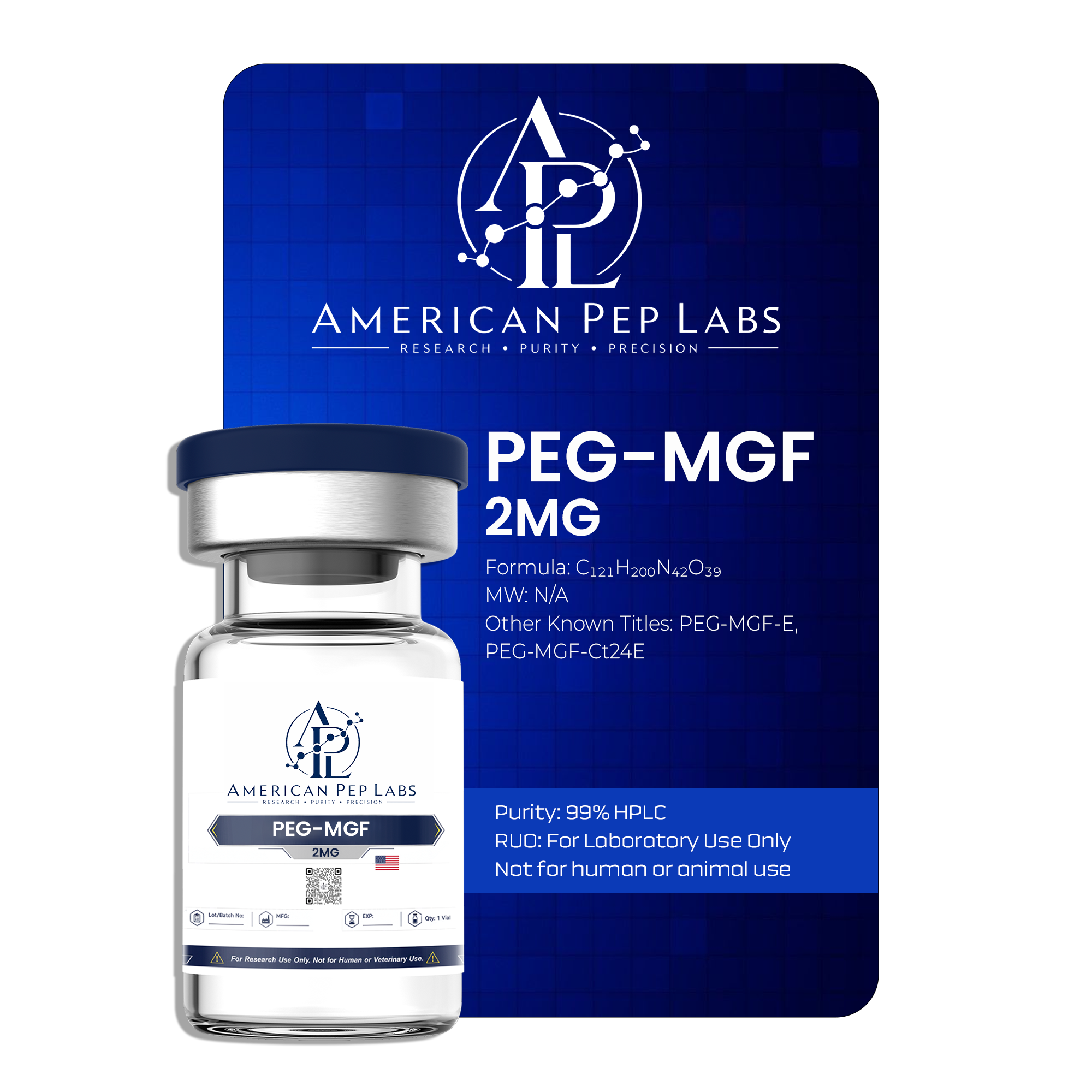
PEG-MGF is a supplier-defined PEGylated peptide construct based on a 24-residue C-terminal E-domain peptide associated with the IGF-1Ec splice variant.
The peptide component is commonly represented as:
YQPPSTNKNTKSQRRKGSTFEERK
The complete PEG-MGF material also contains a covalently attached polyethylene glycol component. However, the commercial name PEG-MGF does not define the PEG chain length, PEG molecular weight, chain number, attachment site, linker chemistry, or degree of PEGylation.
For this reason, PEG-MGF should not be assigned one universal CAS number, molecular formula, or molecular weight unless those values are supported by lot-specific analytical documentation. Multiple current research references explicitly note that PEG-MGF is not a single standardized chemical entity.
Peptide Core Information
Sequence:
Tyr-Gln-Pro-Pro-Ser-Thr-Asn-Lys-Asn-Thr-Lys-Ser-Gln-Arg-Arg-Lys-Gly-Ser-Thr-Phe-Glu-Glu-Arg-Lys
One-Letter Sequence:
YQPPSTNKNTKSQRRKGSTFEE RK
Compact representation:
YQPPSTNKNTKSQRRKGSTFEERK
The unmodified peptide core is approximately 2.87 kDa, while the complete PEGylated construct is heavier by an amount determined by the attached PEG polymer. Current sources caution that total PEG-MGF molecular weight cannot be established from the product name alone.
Research Applications
PEG-MGF may be examined in controlled non-clinical research involving:
- PEGylated peptide characterization
- Bioconjugate analysis
- Peptide-polymer interaction studies
- Structure-function analysis
- Molecular interaction research
- Analytical peptide comparison
- PEG conjugation characterization
- Stability assessment
- Non-clinical biochemical and cellular models
Any findings should remain specific to the exact characterized material tested and should not be interpreted as evidence of muscle-building, recovery, performance enhancement, therapeutic effectiveness, or suitability for human use.
Structural Information
PEG-MGF contains two major structural components:
MGF Peptide Core
A defined 24-residue peptide:
YQPPSTNKNTKSQRRKGSTFEERK
Polyethylene Glycol Component
PEG consists of repeating ethylene oxide units generally represented as:
-(CH₂CH₂O)ₙ-
The value of n, PEG architecture, and attachment chemistry determine the final conjugate’s molecular properties.
Because commercial PEG-MGF products may use different PEG specifications, two materials sold under the same name may not be chemically identical.
Analytical Identification
Relevant characterization should ideally include:
- Peptide core identity confirmation
- Amino-acid sequence verification
- PEG molecular-weight determination
- PEG attachment-site identification
- Degree of PEGylation
- Molecular mass distribution
- Chromatographic purity analysis
- Structural characterization
- Lot-specific quality testing
Specifications & Documentation
Lot-specific documentation should be reviewed for:
- Peptide core identity
- Amino-acid sequence
- PEG molecular weight
- PEG chain architecture
- Attachment chemistry
- Attachment site
- Molecular mass distribution
- Purity specification
- Analytical testing
- Lot or batch information
- Certificate of Analysis
- Storage requirements
The exact COA should be treated as the controlling technical source because the name PEG-MGF alone does not uniquely define the conjugate.
Storage & Handling
Store according to the conditions stated on the product label and Certificate of Analysis. Protect the material from environmental conditions that could compromise peptide or polymer-conjugate integrity.
Handling should follow established laboratory procedures appropriate for research peptide conjugates.
Research Use Only
PEG-MGF is supplied exclusively for laboratory research, analytical testing, and scientific reference purposes.
Disclaimer
For research use only. Not for human or veterinary use. Not intended for consumption, administration, muscle-building use, recovery-related use, performance enhancement, diagnosis, treatment, mitigation, cure, or prevention of any disease. No therapeutic, anabolic, recovery-related, performance-related, medical, or clinical claims are made or implied. Product information is supplied solely for scientific identification, documentation, and research reference.