
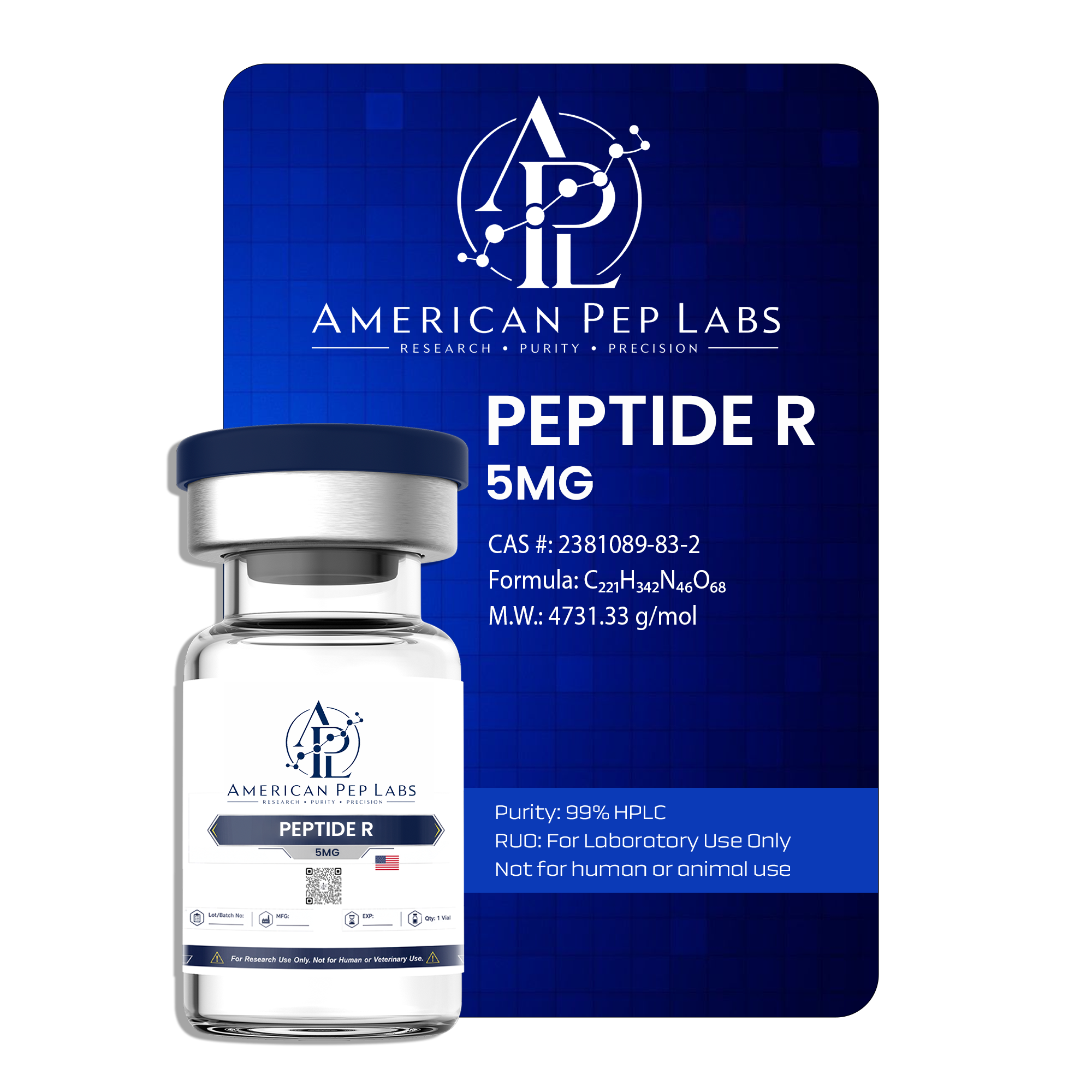
Peptide R, also referred to as Pep R, is a synthetic seven-amino-acid peptide supplied for controlled laboratory, analytical, and scientific research.
Its defined sequence is:
Arg-Ala-Cys-Arg-Phe-Phe-Cys
or:
RACRFFC
A key structural characteristic of Peptide R is the intramolecular disulfide bridge between the cysteine residues at positions 3 and 7, which creates a constrained cyclic region within the peptide. PubChem represents the peptide as H-Arg-Ala-Cys(1)-Arg-Phe-Phe-Cys(1)-OH, with the two cysteine residues connected by the disulfide linkage.
Because commercial Peptide R may be supplied as a TFA-associated preparation or another counter-ion form, final molecular specifications should always be verified against the lot-specific Certificate of Analysis.
Research Applications
Peptide R may be examined in controlled non-clinical research involving:
- Cyclic peptide characterization
- Ligand-receptor interaction studies
- Molecular binding research
- Structure-function analysis
- Disulfide-constrained peptide studies
- Analytical peptide comparison
- Stability assessment
- Non-clinical biochemical and cellular models
Published research has used Peptide R in studies involving CXCR4-associated molecular systems, but these findings should remain confined to the applicable experimental models and should not be interpreted as evidence of therapeutic or clinical effectiveness.
Structural Information
Peptide R contains seven amino-acid residues:
Arg-Ala-Cys-Arg-Phe-Phe-Cys
One-letter sequence:
RACRFFC
Structural representation:
H-Arg-Ala-Cys(1)-Arg-Phe-Phe-Cys(1)-OH
The peptide contains a:
Cys3–Cys7 disulfide bridge
This disulfide linkage forms part of the compound’s defined molecular identity and should be retained in technical documentation.
Salt-Form Considerations
A commonly listed Peptide R record is associated with a TFA preparation and reports:
- CAS #: 1318232-11-9
- Molecular Formula: C₃₉H₅₇N₁₃O₈S₂
- Molecular Weight: Approximately 900.1 g/mol
Because counter-ion and salt form can affect reported molecular specifications, these values should not automatically be applied to a product supplied in a different chemical form.
Analytical Identification
Relevant analytical characterization may include:
- Amino-acid sequence confirmation
- Disulfide-bond verification
- Molecular mass assessment
- Counter-ion identification
- Chromatographic purity analysis
- Structural characterization
- Lot-specific analytical testing
The Cys3–Cys7 disulfide linkage should be considered when confirming the product’s structural identity.
Specifications & Documentation
Lot-specific documentation should be reviewed for:
- Product identity
- Amino-acid sequence
- Disulfide configuration
- CAS number
- Molecular formula
- Molecular weight
- Salt or counter-ion form
- Purity specification
- Analytical testing
- Lot or batch information
- Certificate of Analysis
- Storage requirements
Authenticated product-specific analytical documentation should take precedence over generalized reference data.
Storage & Handling
Store according to the conditions specified on the product label and Certificate of Analysis. Protect the material from environmental conditions that may compromise peptide integrity or disulfide stability.
Handling should follow established laboratory procedures appropriate for research materials.
Research Use Only
Peptide R is supplied exclusively for laboratory research, analytical testing, and scientific reference purposes.
Disclaimer
For research use only. Not for human or veterinary use. Not intended for consumption, administration, oncology-related use, diagnosis, treatment, mitigation, cure, or prevention of any disease. No therapeutic, anticancer, medical, or clinical claims are made or implied. Product information is supplied solely for scientific identification, documentation, and research reference.