
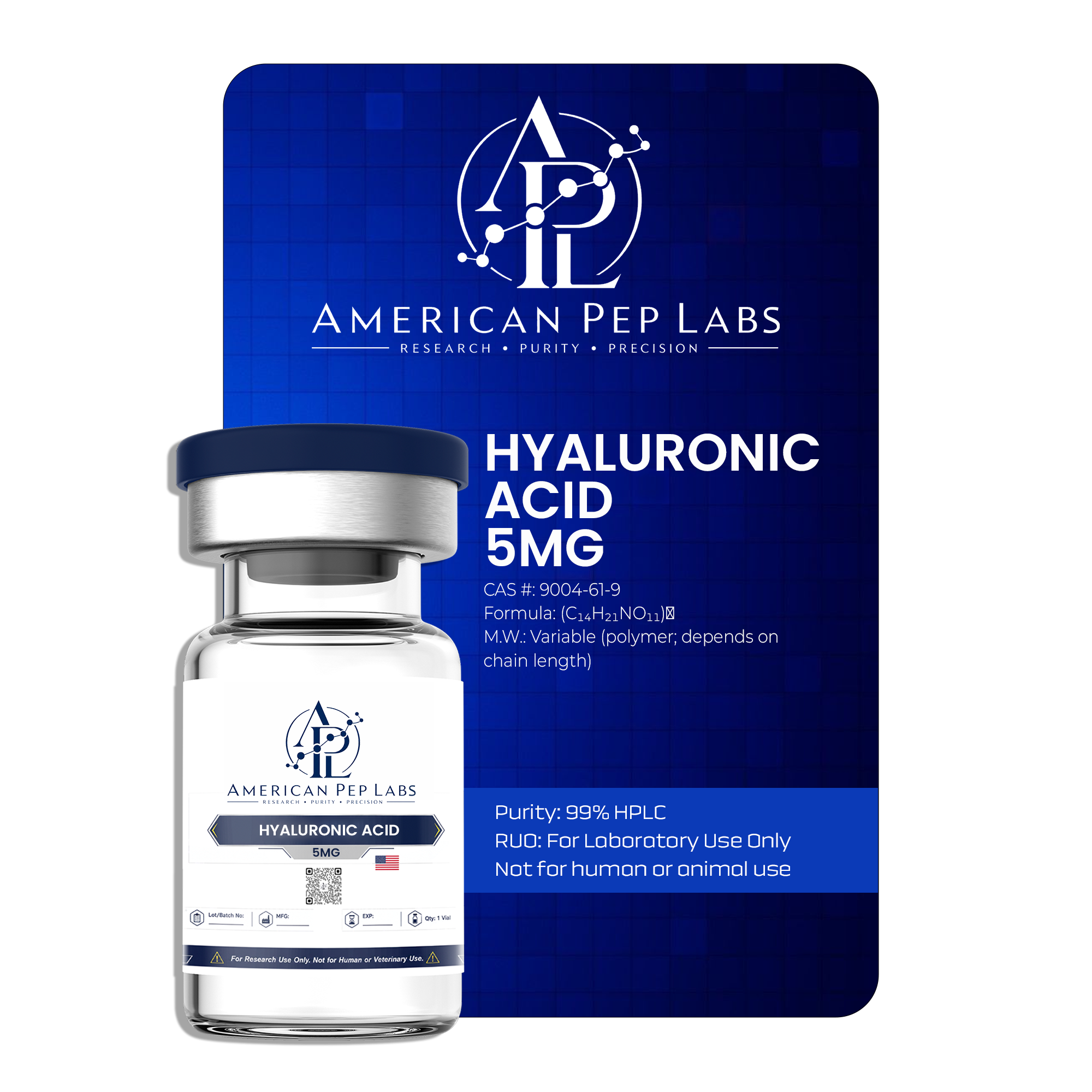
Hyaluronic Acid is a naturally occurring, nonsulfated glycosaminoglycan composed of repeating disaccharide units of D-glucuronic acid and N-acetyl-D-glucosamine.
Unlike peptide-based research materials, Hyaluronic Acid is a polysaccharide polymer and does not possess a conventional amino-acid sequence. Its molecular weight can vary substantially depending on polymer chain length, manufacturing process, and material grade.
PubChem lists Hyaluronic Acid under CAS 9004-61-9 and describes it as a polymer containing alternating glucuronide and glucosaminidic linkages.
For accurate technical documentation, the applicable molecular-weight range, source, purity, viscosity characteristics, and exact chemical form should be taken from the product’s Certificate of Analysis.
Research Applications
Hyaluronic Acid may be examined in controlled laboratory research involving:
- Polysaccharide characterization
- Polymer molecular-weight analysis
- Glycosaminoglycan research
- Molecular interaction studies
- Rheological and viscosity studies
- Stability assessment
- Analytical chemistry
- Non-clinical biochemical and material-science models
Any findings should remain specific to the applicable research system and should not be interpreted as evidence of therapeutic, cosmetic, regenerative, dermatological, or clinical effectiveness.
Structural Information
Hyaluronic Acid is composed of repeating disaccharide units containing:
- D-Glucuronic Acid
- N-Acetyl-D-Glucosamine
The polymer contains alternating glycosidic linkages between these sugar residues.
A generalized repeating-unit representation may be written as:
[GlcA-GlcNAc]ₙ
where n represents the number of repeating disaccharide units in the polymer chain.
Because n varies, Hyaluronic Acid does not have one universal molecular weight.
Molecular Weight Considerations
Hyaluronic Acid products may be classified by molecular-weight range, such as:
- Low molecular weight
- Medium molecular weight
- High molecular weight
Exact numerical ranges differ between manufacturers and grades.
For this reason, the product page should use the lot-specific molecular-weight range stated on the COA rather than assigning one universal value.
Analytical Identification
Relevant characterization may include:
- Polymer identity confirmation
- Molecular-weight distribution
- Molecular-weight range
- Viscosity assessment
- Chromatographic analysis
- Purity testing
- Moisture content
- Lot-specific quality analysis
If the product is supplied as sodium hyaluronate rather than Hyaluronic Acid, its identity and CAS number should be documented separately.
Specifications & Documentation
Lot-specific documentation should be reviewed for:
- Material identity
- Chemical form
- Molecular-weight range
- Polymer distribution
- Purity specification
- Viscosity specification
- Moisture content
- Analytical testing
- Lot or batch identification
- Certificate of Analysis
- Storage requirements
Authenticated product-specific documentation should take precedence over generalized reference information.
Storage & Handling
Store according to the conditions specified on the product label and Certificate of Analysis. Protect the material from moisture, contamination, and environmental conditions that could compromise polymer integrity.
Handling should follow established laboratory procedures appropriate for polymeric research materials.
Research Use Only
Hyaluronic Acid is supplied exclusively for laboratory research, analytical testing, and scientific reference purposes.
Disclaimer
For research use only. Not for human or veterinary use. Not intended for injection, ingestion, cosmetic application, therapeutic use, diagnosis, treatment, mitigation, cure, or prevention of any disease. No therapeutic, cosmetic, regenerative, dermatological, medical, or clinical claims are made or implied. Product information is supplied solely for scientific identification, documentation, and research reference.